


This comes from an anthology of women poets and a compilation of old traditional songs from the area of Fez that would be sung by a chorus of women. In the original format, they are quatrains (“roubai”). I like how earthy it is and of what would be important for a culture at the edge of the desert: water and greenery: and such an abundance of each that one would have gardeners and both cold AND hot water. And who couldn’t use a masseur?
Ancient Songs of the Women of Fez
I want to be in a garden with my love,
empty. Not even a gardener.
I want to be in a bath with my love,
empty. Not even a masseur,
and I’ll bring him all the hot and cold water
he wishes.
even his sweat I’ll collect and put in flasks
so it will make me alive.
the day I am blind from crying,
I will paint my eyes with tears instead of kohl.
Collected by Mohammed el Fasi, transl by Willis Barnstone
Showing posts with label Celebrations. Show all posts
Showing posts with label Celebrations. Show all posts
Wednesday, December 15, 2010


Sunday, November 21, 2010
Sonnet 36 – (Keep your eyes open when you kiss) - John Berryman
 Another selection from John Berryman's sonnets has been long overdue. For some background, the 115 poems, written in the 1940s and in one volume, were a lineal account of a love affair and not published until the mid-1960s. To me, they are on a par with Neruda's, sharing a richness and passion of expression that is dizzying. Both are to be read aloud and large, be it in front of the loved one as declarations or alone, as lamentations. Either way, they are bold and cathartic, with wine or whiskey, day or night. Sometimes, the syntax in Berryman can sound "Yoda-ish" by its placement of nouns and verbs, and it takes a little bit of effort to "get" all he is doing with language. But the prize.... the prize when you do is so satisfying that you'll be ashamed of having complained. Here, in this early one in the arc of the relationship, he turns the traditional "close your eyes when kissing" on its head and riffs on it.... while sticking to the sonnet structure. Wow!
----------------------------------------------------------------
Sonnet 36 – (Keep your eyes open when you kiss) – John Berryman
Keep your eyes open when you kiss: do: when
You kiss. All silly time else, close them to;
Unsleeping, I implore you (dear) pursue
In darkness me, as I do you again
Instantly we part . . only me both then
And when your fingers fall, let there be two
Only, “in that dream-kingdom”: I would have you
Me alone recognize your citizen.
Before who wanted eyes, making love, so?
I do now. However we are driven and hide,
What state we keep all other states condemn,
We see ourselves, we watch the solemn glow
Of empty courts we kiss in . . Open wide
You do, you do, and I look into them.
John Berryman
Saturday, November 20, 2010
" It Is Marvellous..." - Elizabeth Bishop
 I know that I am supposed to like Elizabeth Bishop (1911 - 1979) and I certainly respect her work - but she has never been appealing personally except for her translations of Brazilian poets. As the biographical synopsis tells (click on her name above), she had a tragic personal life one wouldn't wish on an enemy. Her father died when she was one year old, her mother placed permanently in a mental institution when Elizabeth was five years old, and later, her long-term lover in Brazil committed suicide. Wealthy grandparents provided an education (Vassar) and financial freedom which led to travel abroad and, eventually, fourteen years in Brazil until returning to the USA in 1970 to teach at Harvard. Work published work in her lifetime - only 101 poems - was good enough to win both a Pulitzer and a National Book Award for Poetry. Her reputation has grown in stature since her death.
 This poem IS marvellous for how it paints scene, setting, and atmosphere to perfection. The details build unrushed to the final result the way a cook adds each ingredient, in the right amount and at the right time, to make an edible perfection. (I was making a smoked salmon corn chowder yesterday.) Enjoy!
----------------------------------------------------------
“It Is Marvellous…”
It is marvellous to wake up together
At the same minute; marvellous to hear
The rain begin suddenly all over the roof,
To feel the air suddenly clear
As if electricity had passed through it
From a black mesh of wires in the sky.
All over the roof the rain hisses,
And below, the light falling of kisses.
An electrical storm is coming or moving away;
It is the prickling air that wakes us up.
If lightning struck the house now, it would run
From the four blue china balls on top
Down the roof and down the rods all around us,
And we imagine dreamily
How the whole house caught in a bird-cage of lightning
Would be quite delightful rather than frightening;
And from the same simplified point of view
Of night and lying flat on one's back
All things might change equally easily,
Since always to warn us there must be these black
Electrical wires dangling. Without surprise
The world might change to something quite different,
As the air changes or the lightning comes without our blinking,
Change as the kisses are changing without our thinking.
Elizabeth Bishop
Wednesday, November 10, 2010
Anonymous - Ancient Egypt
This is another of the poems translated into English by Ezra Pound and Noel Stock from Italian text translated, in turn, from hieroglyphic texts dating from between 1567 B.C. to 1085 B.C.). The Italian version is called "Liriche Amorose Degli Antichi Egizioni" (Milan, 1957). Though the author will never be known, her sentiments are timeless and fresh across three millennia. The plainness of the images reminds me of Archibald Macleish’s poem (also posted) to his wife.
————————————————-
Untitled
Transl. By Ezra Pound and Noel Stock
I find my love fishing
His feet in the shallows.
We have breakfast together
And drink beer.
I offer him the magic of my thighs
He is caught in the spell.
Wednesday, October 6, 2010
A Mutual Lullaby - Yehuda Amichai
With this one, I think Amichai takes the lead with most poems here.... And is it any wonder? PLEASE read some of the others and you'll see why. It's worth learning Hebrew just to get their full impact!
As for including this one..... read it.
---------------------------------------------------------------
A Mutual Lullaby
For a while I've been meaning to tell you to sleep
but your eyes won't let sleep in, and your thighs
won't either. Your belly when I touch -- perhaps.
Count backward now, as if at a rocket launching,
and sleep. Or count forward,
as if you were starting a song. And sleep.
Let's compose sweet eulogies for each other as we lie together in the dark.
Tears remain longer than whatever caused them.
My eyes have burned this newspaper to a mist
but the wheat goes on growing in Pharahoh's dream.
Time isn't inside the clock
but love, sometimes, is inside our bodies.
Words that escape you in your sleep
are food and drink for the wild angels,
and our rumpled bed
is the last nature preserve
with shrieking laughter and lush green weeping.
For a while I've been meaning to tell you
that you should sleep
and that the black night will be cushioned
with soft red velvet - as in a case
for geometrical instruments --
around everything that's hard in you.
And that I'll keep you, as people keep the Sabbath,
even on weekdays, and that we'll stay together always
as on one of those New Year's cards
with a dove and a Torah, sprinkled with silver glitter.
And that we are still less expensive
than a computer. So they'll let us be.
Yehuda Amichai - Israeli
See? I didn't want to ruin it for you, dear reader, with extraneous comments/observations.
As for including this one..... read it.
---------------------------------------------------------------
A Mutual Lullaby
For a while I've been meaning to tell you to sleep
but your eyes won't let sleep in, and your thighs
won't either. Your belly when I touch -- perhaps.
Count backward now, as if at a rocket launching,
and sleep. Or count forward,
as if you were starting a song. And sleep.
Let's compose sweet eulogies for each other as we lie together in the dark.
Tears remain longer than whatever caused them.
My eyes have burned this newspaper to a mist
but the wheat goes on growing in Pharahoh's dream.
Time isn't inside the clock
but love, sometimes, is inside our bodies.
Words that escape you in your sleep
are food and drink for the wild angels,
and our rumpled bed
is the last nature preserve
with shrieking laughter and lush green weeping.
For a while I've been meaning to tell you
that you should sleep
and that the black night will be cushioned
with soft red velvet - as in a case
for geometrical instruments --
around everything that's hard in you.
And that I'll keep you, as people keep the Sabbath,
even on weekdays, and that we'll stay together always
as on one of those New Year's cards
with a dove and a Torah, sprinkled with silver glitter.
And that we are still less expensive
than a computer. So they'll let us be.
Yehuda Amichai - Israeli
See? I didn't want to ruin it for you, dear reader, with extraneous comments/observations.
Thursday, September 16, 2010
A Decade - Amy Lowell
Amy Lowell (1874-1925) came from a privileged and wealthy background, a true-blue "Boston Brahmin" who became an influential figure in championing and publicizing the Imagist movement exemplified by Ezra Pound. While her dedication and energy to furthering poetry made T.S. Eliot call her "the demon saleswoman of poetry", Pound, after he and Lowell had a falling out, called her "hippopoetess", a reference to her large size. Educated by tutors, private schools and self-guided reading, Amy wrote from an early age and was published in numerous journals besides being an editor, critic and lecturer. She won a Pulitzer in 1925 for her collection of poems, What's A Clock. Somewhat forgotten after her death, interest in her revived with the interest in women/lesbian writers during the emergence of the women's movement in mid-late 20th century. While she did live with a woman for the last decade or so of her life AND her poetry could be erotic (as the one below), there is no "smoking gun" about her sexual orientation since her lov... er, companion burned all the personal papers. Regardless, "A Decade" is a jewel, for a man or a woman. I particularly like how it speaks to both the immediate experience and how it transforms as it repeats over time into something sustaining as well for "a decade"...
--------------------------
A Decade
When you came, you were like red wine and honey,
And the taste of you burnt my mouth with its sweetness.
Now you are like morning bread,
Smooth and pleasant.
I hardly taste you at all for I know your savour,
But I am completely nourished.
Amy Lowell
--------------------------
A Decade
When you came, you were like red wine and honey,
And the taste of you burnt my mouth with its sweetness.
Now you are like morning bread,
Smooth and pleasant.
I hardly taste you at all for I know your savour,
But I am completely nourished.
Amy Lowell
Thursday, June 24, 2010
Sonnet LV - Shakespeare
(Is it REALLY necessary that Shakespeare needs an introduction?? By me??? I didn't think so!) Here, after 100+ poems by others, the first one by Shakespeare. "Shall I compare thee to a summer's day?" (Sonnet XVIII) is better known, but I like this one for its topic. Rather than praising her beauty , he speaks to the immortality of his love for her through the existence of the poem. What a gift!
----------------------------------------
Sonnet LV
Not marble nor the gilded monuments
Of princes shall outlive this pow’rful rhyme;
But you shall shine more bright in these contents
Than unswept stone, besmeared with sluttish time.
When wasteful war shall statues overturn,
And broils root out the work of masonry,
Nor Mars his sword nor war’s quick fire shall burn
The living record of your memory.
‘Gainst death and all-oblivious enmity
Shall you pace forth; our praise shall still find room
Even in the eyes of all posterity
That wear this world out to the ending doom.
So, till the judgment that yourself arise
You live in this, and dwell in lovers’ eyes.
William Shakespeare - English
----------------------------------------
Sonnet LV
Not marble nor the gilded monuments
Of princes shall outlive this pow’rful rhyme;
But you shall shine more bright in these contents
Than unswept stone, besmeared with sluttish time.
When wasteful war shall statues overturn,
And broils root out the work of masonry,
Nor Mars his sword nor war’s quick fire shall burn
The living record of your memory.
‘Gainst death and all-oblivious enmity
Shall you pace forth; our praise shall still find room
Even in the eyes of all posterity
That wear this world out to the ending doom.
So, till the judgment that yourself arise
You live in this, and dwell in lovers’ eyes.
William Shakespeare - English
Sunday, June 20, 2010
What He Said - Kapilar
One objective of this blog has been to show how the need for lovers to write about experiences is both universal and timeless. Today's selection, dating from roughly 1800 - 2000 years ago and from the Tamil-speaking region now covering present-day Malaysia, Sri Lanka, and southern India, does both. It comes from the Eight Anthologies (circa 1st - 3rd century), the earliest recorded Tamil-language poetry. Kapilar, the author, is considered one of the great Sangam "school" poets, well-regarded in his society, and a poet in the court of the king. This poem is an "interior" poem, so-called as they are "...dramatic monologues in which five landscapes (hill, seashore, forest, arable land, desert) and their contents (birds, beasts, trees, tribes, characteristic arts and occupations) correspond to the phases of love (first union, anxious waiting, infidelity, elopement, patient waiting and reunion)". These would contrast to "exterior" poems that were meditations "... and sometimes grim elegies". One does not need to be in that time and place to appreciate the poet's feelings about the secrecy of a clandestine love.
-----------------------------------------
What He Said
My love is a two-faced thief.
In the dead of night
she comes like the fragrance
of the Red-Speared Chieftain’s forest hills,
to be one with me.
And then, she sheds the petals
of night’s several flowers,
and does her hair again
with new perfumes and oils,
to be one with her family at dawn
with a stranger’s different face.
Kapilar - Tamil
-----------------------------------------
What He Said
My love is a two-faced thief.
In the dead of night
she comes like the fragrance
of the Red-Speared Chieftain’s forest hills,
to be one with me.
And then, she sheds the petals
of night’s several flowers,
and does her hair again
with new perfumes and oils,
to be one with her family at dawn
with a stranger’s different face.
Kapilar - Tamil
Sunday, June 13, 2010
Two Poems (the second one) - Kenneth Rexroth

Rexroth also had an early interest in poetry from other cultures and eras, and his compilations of Chinese and Japanese poetry helped popularize those and their influence on American poetry. As a poet, he never garnered the major writing awards, but his devotion to poetry and its place in society was recognized by a lifetime achievement award from The Academy of American Poets. I chose this one because its representative of one of his themes (erotic poetry), part of a broader "anti-establishment" thread in his outlook and writings.
---------------------------------------------------
Two Poems (second one)
I like to think of you naked.
I put your naked body
Between myself alone and death.
If I go into my brain
And set fire to your sweet nipples,
To the tendons beneath your knees
I can see far before me.
It is empty there where I look,
But at least it is lighted.
I know how your shoulders glisten,
How your face sinks into trance,
And your eyes like a sleepwalker’s,
And your lips of a woman
Cruel to herself.
I like to
Think of you clothed, your body
Shut to the world and self contained,
Its wonderful arrogance
That makes all women envy you.
I can remember every dress,
Each more proud that a naked nun.
When I go to sleep my eyes
Close in a mesh of memory.
Its cloud of intimate odor
Dreams instead of myself.
Kenneth Rexroth - American
Sunday, June 6, 2010
Sonnet LI (100 Love Sonnets) - Pablo Neruda

---------------------------------
Sonnet LI
transl. from Spanish by Stephen Tapscott
Your laugh: it reminds me of a tree
fissured by a lightning streak, by a silver bolt
that drops from the sky, splitting the poll,
slicing the tree with its sword.
A laugh like yours I love is born
only in the foliage and snow of the highlands,
the air’s laugh that bursts loose in those altitudes,
dearest: the Araucanian tradition.
O my mountain woman, my dear Chillán volcano,
slash your laughter through the shadows
the night, morning, honey of the noon:
birds of the foliage will leap in the air
when your laugh like an extravagant
light breaks through the tree of life.
Pablo Neruda
Friday, June 4, 2010
Four Songs - Tzu Yeh
Some suggest that the group of 117 short poems known as the "Tzu Yeh songs" were authored by more than one person. However, the compositional style of back-to-back couplets was new and suggest a single author. As a "wine-shop girl", she would have been ".... trained in music, dance, calligraphy, history..." (Hamill), making her a very early precursor - by roughly 1,300 years - of Japanese "geishas". I'm sure some doctoral student somewhere has done a cross-cultural comparison of female entertainers in ancient cultures - from the Greek hetaerae to "wine-shop girls" to geishas - and what was included in their range of offerings, from chaste to carnal.) This grouping of Tzu Yeh songs first showed up in a compilation dating to the second half of the 4th Century A.C.E. (After Christian Era - the new "A.D.") I've selected four of them for this posting: I may add others at another time. (Sorry, no photo!)
---------------------------------------------------------
Four songs
---------------------------------------------------------
Four songs
transl. from Chinese by Sam Hamill
The Lotus Lover
A green lotus on waves of transparent blue:
the flowers grow red and new.
You want to collect these lovely flowers?
I’ll give my lotus bud to you.
And End to Spring
Your leaving brought an end to spring;
longing burns through summer heat-waves.
Will I ever lift my dress for you again?
My pillow ever hold your lovely face?
A Smile
In this house without walls on a hill
the four winds touch our faces.
If they blow open your robe of gauze,
I’ll try to hide my smile.
Song
Winter skies are cold and low,
with harsh winds and freezing sleet.
But when we make love beneath our quilt,
we make three summer months of heat.
Tzu Yeh - Chinese
Tuesday, June 1, 2010
The Bed - Thom Gunn
Another by Thom Gunn, who transplanted to the West Coast from England decades ago, and became a part of the San Francisco poetry "scene". Not a great poem but a good rendering of an experience we have all had.
-------------------------------------
The Bed
-------------------------------------
The Bed
The pulsing stops where time has been,
The garden is snow-bound,
The branches weighed down and the paths filled in,
Drifts quilt the ground.
We lie soft-caught, still now it’s done,
Loose-twined across the bed
Like wrestling statues; but it still goes on
Inside my head.
Thom Gunn - American
Monday, May 31, 2010
The Moment - Theodore Roethke
Another - check out the earlier ones here - by one of most astonishing poetic voices in English of the 20th century, Theodore Roethke. His poems shift the ground beneath how we see things: I always go away with images I never imagined possible. In this one, he begins with complexity and ends with such simple words that say and mean so much....
-------------------------
The Moment
We passed the ice of pain,
And came to a dark ravine,
And there we sang with the sea;
The wide, the bleak abyss
Shifted with our slow kiss.
Space struggled with time;
the gong of midnight struck
The naked absolute.
Sound, silence sang as one.
All flowed: without, within;
Body met body, we
Created what’s to be.
What else to say? –
We end in joy.
Theodore Roethke - American
-------------------------
The Moment
We passed the ice of pain,
And came to a dark ravine,
And there we sang with the sea;
The wide, the bleak abyss
Shifted with our slow kiss.
Space struggled with time;
the gong of midnight struck
The naked absolute.
Sound, silence sang as one.
All flowed: without, within;
Body met body, we
Created what’s to be.
What else to say? –
We end in joy.
Theodore Roethke - American
Saturday, May 29, 2010
The First Of All My Dreams - e.e. cummings
Not a poem that I've seen anthologized often and one of few where there is capitalization in an e.e. cummings poem. I believe it is a fairly early one. The appeal to me is in the last line, though the entire poem speaks to the maelstrom of conflicting emotions within each of us during those early - there should be a special word for that period! - moments/days of courtship. (And what has happened to courtship, in general??) This one has innocence, happy uncertainty, and a wonderful denouement.
---------------------------------------------
The First Of All My Dreams
the first of all my dreams was of
a lover and his only love,
strolling slowly (mind in mind)
through some green mysterious land
until my second dream begins –
the sky wild with leaves; which dance
and dancing swoop (and swooping
whirl
over a frightened boy and girl)
but that mere fury soon became
silence: in huger always whom
two tiny selves sleep (doll by doll)
motionless under magical
foreverfully falling snow.
And then this dreamer wept: and so
she quickly dreamed a dream of spring
- how you and I are blossoming.
e.e. cummings- American
---------------------------------------------
The First Of All My Dreams
the first of all my dreams was of
a lover and his only love,
strolling slowly (mind in mind)
through some green mysterious land
until my second dream begins –
the sky wild with leaves; which dance
and dancing swoop (and swooping
whirl
over a frightened boy and girl)
but that mere fury soon became
silence: in huger always whom
two tiny selves sleep (doll by doll)
motionless under magical
foreverfully falling snow.
And then this dreamer wept: and so
she quickly dreamed a dream of spring
- how you and I are blossoming.
e.e. cummings- American
Sunday, May 23, 2010
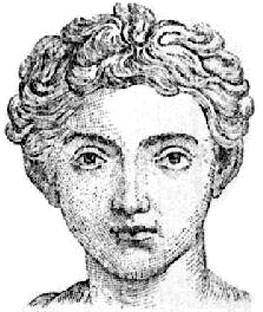
V - Catullus
-------------------------------
V
So let’s live - really live! – for love and loving,
honey! Guff of the grumpy old harrumph!-ers
- what’s it worth? Is it even worth a penny?
Suns go under and bubble bright as ever
up but – smothered, our little light, the night’s one
sudden plunge – and oblivion forever.
Kiss me! kiss me a thousand times! A hundred!
Now a thousand again! Another hundred!
Don’t stop yet. Add a thousand. And a hundred.
So. Then post, sitting pretty on our millions,
sums that none – we the least – make head or tail of.
Don’t let’s know, even us. Or evil eyes might
glitter green, over such a spell of kisses.
Catullus - Roman
Saturday, May 22, 2010
Reconciliation - Goethe
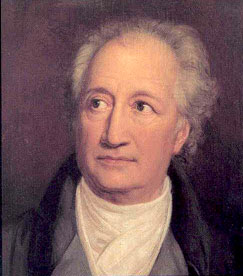
 Few in history, particularly literary history, become so well known that just their last name is enough as an identifier. Goethe (Johann Wolfgang von Goethe, 1749-1832) is one of those. (Napoleon told him when they met that he had read "The Sorrows of Young Werther" - the novel that, early-on, made Goethe's reputation - seven (7) times!) Goethe is to German letters what Victor Hugo was to French: a definer of national character. His poetry has a lyricism and rhyming that is difficult to translate, partly because of German syntax and grammar. I have never been fond of his poetry, but that's personal taste, although I do admire how he lived his life: fully and passionately. At age 74, he fell madly in love with 18 (!) year-old Ulrike von Levetzow (photo here), followed her from one city to another, proposed through a friend, was turned down and wrote his most personal love poem, "Marienbad Elegy" (click here for full text - it's long), proving again the adage that "there is no fool, like an old fool".... (She lived until 1899 and died at the age of 95.) This poem, in the aftermath, is an exhortation to recovery after a heart-break.
 ------------------------------------------------------------------
Reconciliation
transl. from German by John Frederick Nims
Passion, and then the anguish. And with whom
To soothe you, heavy heart that lost so much?
Love’s hour escaped, unstoppered like perfume?
The loveliest – all for nothing – within touch?
Cloudy the mind; mere muddle all it tries.
And the great world adrift before the eyes.
Then music to the fore like angels swarming,
A million tones in galaxy. We surrender
All of our inner fort to forces storming
- Irresistibly overrun with splendor.
The eye goes damp: in longings past tomorrow
We guess at the infinite worth of song and sorrow.
And so the heart, disburdened, in a flash
Knows: I endure, and beat, and pound with pleasure!
Gives itself over utterly, in rash
Thanks for the windfall, life. No common treasure.
Yearns: could it only last! – our feeling of
Fortune on fortune doubled, song and love.
J. Wolfgang von Goethe - German
Wednesday, May 12, 2010
She - Theodore Roethke
This is one of his more anthologized poems - and the second one in this blog - but that's not a reason to exclude it. Comparing his imagery to, say Rod McKuen, is like comparing a Ferrari to a Trabant: they both get you to a destination, but the rides are totally different. Reading Roethke is always a joy to me because I can feel new pathways, new ways of seeing connections.
This poem always conjures up for me that opening shot in "The Sound of Music", when Julie Andrews is on a hill-top meadow singing "The Hills Are Alive With The Sound of Music". She is so full of joy and exhilaration twirling, her arms and face to the sky. This has that same euphoric joy and innocence.... and more. Roethke's talent/genius is in seamlessly slipping in the sexual imagery without distracting from the overall "wholesomeness". It's one of my favorite poems.
---------------------------------
She
I think the dead are tender. Shall we kiss? –
My lady laughs, delighting in what is.
If she but sighs, a bird puts out its tongue.
She makes space lonely with a lovely song.
She lilts a low soft language, and I hear
Down long sea-chambers of the inner ear.
We sing together; we sing mouth to mouth.
The garden is a river flowing south.
She cries out loud the soul’s own secret joy;
She dances, and the ground bears her away.
She knows the speech of light, and makes it plain
A lively thing can come to life again.
I feel her presence in the common day,
In that slow dark that widens every eye.
She moves as water moves, and comes to me,
Stayed by what was, and pulled by what would be.
Theodore Roethke - American
This poem always conjures up for me that opening shot in "The Sound of Music", when Julie Andrews is on a hill-top meadow singing "The Hills Are Alive With The Sound of Music". She is so full of joy and exhilaration twirling, her arms and face to the sky. This has that same euphoric joy and innocence.... and more. Roethke's talent/genius is in seamlessly slipping in the sexual imagery without distracting from the overall "wholesomeness". It's one of my favorite poems.
---------------------------------
She
I think the dead are tender. Shall we kiss? –
My lady laughs, delighting in what is.
If she but sighs, a bird puts out its tongue.
She makes space lonely with a lovely song.
She lilts a low soft language, and I hear
Down long sea-chambers of the inner ear.
We sing together; we sing mouth to mouth.
The garden is a river flowing south.
She cries out loud the soul’s own secret joy;
She dances, and the ground bears her away.
She knows the speech of light, and makes it plain
A lively thing can come to life again.
I feel her presence in the common day,
In that slow dark that widens every eye.
She moves as water moves, and comes to me,
Stayed by what was, and pulled by what would be.
Theodore Roethke - American
Friday, May 7, 2010
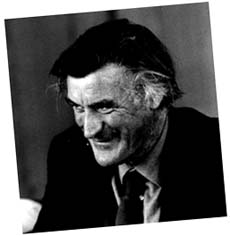
September - Ted Hughes
---------------------------------------------------------
September
We sit late, watching the dark slowly unfold:
No clock counts this.
When kisses are repeated and the arms hold
There is no telling where time is.
It is midsummer: the leaves hang big and still:
Behind the eye a star,
Under the silk of the wrist a sea, tell
Time is nowhere.
We stand; leaves have not timed the summer.
No clock now needs
Tell we have only what we remember:
Minutes uproaring with our heads
Like and unfortunate King’s and Queen’s
When the senseless mob rules;
And quietly the trees casting their crowns
Into the pools.
Ted Hughes - English
Sunday, May 2, 2010
As we are so wonderfully done with each other - Kenneth Patchen
(Patchen is already represented through another poem, so bio info is with that one.) I don't know of another poem that captures, as well as this one, that sense of marvel and wonder that is the "after-glow"....
---------------------------------------------------------------------------
As we are so wonderfully done with each other
As we are so wonderfully done with each other
We can walk into our separate sleep
On floors of music where the milkwhite cloak of childhood
lies
Oh my love, my golden lark, my soft long doll
Your lips have splashed my house with print of flowers
My hands are crooked where they spilled over your dear
curving
It is good to be weary from that brilliant work
It is being God to feel your breathing under me
A waterglass on the bureau fills with morning…
Don’t let anyone in to wake us
Kenneth Patchen - American
---------------------------------------------------------------------------
As we are so wonderfully done with each other
As we are so wonderfully done with each other
We can walk into our separate sleep
On floors of music where the milkwhite cloak of childhood
lies
Oh my love, my golden lark, my soft long doll
Your lips have splashed my house with print of flowers
My hands are crooked where they spilled over your dear
curving
It is good to be weary from that brilliant work
It is being God to feel your breathing under me
A waterglass on the bureau fills with morning…
Don’t let anyone in to wake us
Kenneth Patchen - American
Wednesday, April 28, 2010
Gifts - Marilyn Hacker
(See other of her poems here for biographical background.) I collect stones from places visited - Delphi, Santorini, Block Island, Point Reyes, the castle where Richard the Lionhearted was held, a beach in Orkney... - so this poem has always had a special appeal.
-----------------------------
Gifts
Here. Between us I’ve placed a smooth stone,
green-veined, with finger-fissures, and a cracked
blue bowl with three yellow pears, and seven miles
of jagged coves, pebbled and bouldered, the jade sea
drooling and frothing them, one dwarfed tree,
a crooked surviving pine, on a tumbled cliff
lookout point. Hold the stone
in your palm, cold
from morning draughts on the window-sill.
The touched side takes your warmth. The cool
side rubs your lips. Your mouth
is on my hand.
Marilyn Hacker - American
-----------------------------
Gifts
Here. Between us I’ve placed a smooth stone,
green-veined, with finger-fissures, and a cracked
blue bowl with three yellow pears, and seven miles
of jagged coves, pebbled and bouldered, the jade sea
drooling and frothing them, one dwarfed tree,
a crooked surviving pine, on a tumbled cliff
lookout point. Hold the stone
in your palm, cold
from morning draughts on the window-sill.
The touched side takes your warmth. The cool
side rubs your lips. Your mouth
is on my hand.
Marilyn Hacker - American
Subscribe to:
Posts (Atom)