Showing posts with label Desolations. Show all posts

Monday, October 25, 2010

When I Think About Why - Anonymous, Korean


"Anonymous" has always been a prolific author across the centuries.... This one is from 16th century Korea.  Given how hand fans were used by both men and women, one should pause before assuming it's a woman speaking.  That ambiguity is one reason I like it.  The other is how it says so much in so few words and uses very simple imagery to speak about so much.  (Think about all the questions you have after reading!)  And it has that wistful melancholy that is very Asian and familiar (to me).
-----------------------------------------------------------------------
When I Think About Why
                                                   transl. V O. Baron and Chung Seuk Park

When I think about why
You sent that fan to me,
I wonder if you meant
For me to blow out the fire in my heart.

How could I put out a fire with a fan
When teardrops failed?

                                                Anonymous – 16th Century  Korean

Wednesday, October 20, 2010

Nineteen Ancient Poems - #2 - Anonymous (Chinese)


 The "Nineteen Ancient Poems" are the earliest extant poems in the five-character meter that was the longest lasting form of Chinese poetry.  They date back almost 2000 years, author(s) unknown.  Translations, as I keep repeating, are - at best - like seeing an object through a prism, at least in terms of getting at the essence of the original.  There have been different schools of thought about translating from the Chinese, from rhyming and meter schemes that simulated and emulated the original, to the one below, which attempts to capture some of the rhythm and sing-song repetition in the original.  Over the years, my yard-stick is whether it conveys the overall atmosphere and tone by which our emotional reaction is created.  For me, this one succeeds and that's why it's included: that sorrow and moodiness of a loss observed and felt is a theme that recurs in later Chinese poetry.  Remember: this was written almost 2000 years ago....
----------------------------------------------------------
Nineteen Ancient Poems - #2

Green, so green is the river grass,
thick so thick are the garden willow’s leaves.
Beautiful, so beautiful is the lady upstairs.,
shining as she stands by the window, shining.
Pretty in her powdered rouge, so pretty
with her slender, slender white hands.
Once she was a singing girl,
but now is the wife of a womanizer.
He travels but rarely comes home.
So hard to sleep in an empty bed.

                                Anonymous – Chinese, Han Dynasty, 206 BCE – 220 CE

Sunday, October 10, 2010

Places, Loved Ones - Philip Larkin

The fifth selection by Philip Larkin and the one that most disturbs the Romantic - capital "R", not lower case - in me. His place and talent in the 20th century English poets' pantheon is secure, but I venture that his private life and "success" in love relationships was neither carefree or smooth.  His "love" poems, while personally affecting - in particular the truths in "Talking In Bed" - require thought, reflection, and multiple readings.  They manage to get to the heart, but not by a straight path.   This one "bothers" me the most.  It has some lines, like the last four in the first verse,  that are just perfection in a few words.  And the entire second verse.  But then, he smacks you with the concluding verse, which makes you ponder.... everything.  Brilliant, effective, and ...... frightening.  (Your thoughts?)
-------------------------

Places, Loved Ones

                         
No, I have never found
The place where I could say

This is my proper ground,

Here I shall stay;
Nor met that special one
Who has an instant claim
On everything I own
Down to my name

To find such seems to prove
You want no choice in where
To build, or whom to love;
You ask them to bear
You off irrevocably,
So that it’s not your fault
Should the town turn dreary,
The girl, a dolt.

Yet, having missed them, you’re
Bound, none the less, to act
As if what you settled for
Mashed you, in fact;
And wiser to keep away
From thinking you still might trace
Uncalled-for to this day
Your person, your place.
                                                              Philip Larkin - English

Tuesday, July 20, 2010

Wild Oats

This is the fifth poem by Larkin in this anthology and it’s one that straddles my self-imposed/copied categories.  One could call it an  “Intimations” poem as much as a “Separations” or “Desolations” one.  It really doesn’t fit neatly in any, but it belongs in this anthology precisely because it mirrors real life: sometimes it’s just impossible to categorize a relationship (or its place) in the “love relationship pantheon”.  I’ve “liked” it because of how compresses the whole arc of a seven year into just a few lines, but the sparseness of details does not deter one from absolutely “getting” what it was to the writer.  There is a sadness in how desultory it was or meaningful (or not) to him.  He isn’t quite a cad but certainly not a noble soul.  And he doesn’t seem to have learned anything from the years it took of his (and her) life, even while “reflecting” through this account of the relationship.  It leaves me both sad for him and wondering how many of us have had his kind of experience. 

About twenty years ago
Two girls came in where I worked—
A bosomy English rose
And her friend in specs I could talk to.   
Faces in those days sparked
The whole shooting-match off, and I doubt   
If ever one had like hers:
But it was the friend I took out,

And in seven years after that   
Wrote over four hundred letters,   
Gave a ten-guinea ring
I got back in the end, and met   
At numerous cathedral cities   
Unknown to the clergy. I believe
I met beautiful twice. She was trying   
Both times (so I thought) not to laugh.

Parting, after about five
Rehearsals, was an agreement   
That I was too selfish, withdrawn,   
And easily bored to love.
Well, useful to get that learnt.   
In my wallet are still two snaps
Of bosomy rose with fur gloves on.   
Unlucky charms, perhaps.

Saturday, June 26, 2010

How Can A Pain In The Chest Be Softened - Majnun Laila

This poem comes from a tragic Arab love story based on a (supposedly) real person, Qays ibn al-Mulawwah, who lived in the late 600s A.D. in the northern Arabian peninsula,  fell in love with a woman (Layla), was not allowed to marry her, and became a mad poet living in the desert.  (He became known is "Majnun-e Layla" or "Layla's Madman".)  Really.  In another version, they lived in India.  Versions of the poems were collected in later centuries by Persian writers and passed into their literary realm.  (There is a 1933 Indian movie (Laila Majnun) as well as a more recent Bollywood version.)  

Regardless, someone wrote the group of poems about star-crossed lovers,  from which comes  this one.  I can't vouch for the quality of the translation, but given that these poems began in folklore, the vernacular tone is not surprising.  No matter: the ache of the longing cuts through the centuries and the language barrier.  The last two lines resonate to the point where, if I were a bridge, they would be an army of words marching across with such force and cadence that I would collapse.
------------------------------------------------
How Can A Pain In The Chest Be Softened?

How can a pain in the chest be softened?
The darts of death are closer than your hands.
Too much loss; too much want; absence. I tremble,
You can’t come to me, I can’t come to you.
Our love is a small bird tied by a child,
The bird sips the lake of death and the boy
Goes on with his game. He doesn’t have the sense
To feel the bird’s pain: and the wings can’t fly.
I know a thousand roads, a thousand places,
But without a heart there is nowhere to go.

                                                                       Majnun Laila ( ? -682) Arab

Wednesday, June 23, 2010

Love - Philip Larkin

And a third one by Larkin.... If you've read the other two posted here, you may be seeing a pattern to his love poetry: a voice that is a bit sour on the whole thing, a little skeptical.... yet with a grudging hopefulness that comes through (at least in my read).  Yet, always, incisive observations from his dissection of what it all means.
----------------------------------------
Love

The difficult part of love
Is being selfish enough,
Is having the blind persistence
To upset an existence
Just for your own sake.
What cheek it must take.

And then the unselfish side –
How can you be satisfied,
Putting someone else first
so that you come off worst?
My life is for me.
As well ignore gravity.

Still, vicious or virtuous,
Love suits most of us.
Only the bleeder found
Selfish this wrong way round
Is ever wholly rebuffed,
And he can get stuffed.

Philip Larkin

Tuesday, June 22, 2010

"Love, we must part now"

Only the second by Larkin here - you MUST read the other one, as it is one of my all-time favorites.  To have such a command of structure - ever try writing a sonnet? no? TRY! - and still be creative is something I envy.  I like the closing lines, not of ships "passing in the night", but deliberately sailing apart, at dawn "...wet with light.." What a line! How beautiful.... How sad....  And, of course, my reason for selecting it: how unlike reality.
--------------------------------------
“Love, we must part now”

Love, we must part now: do not let it be
Calamitous and bitter. In the past
There has been too much moonlight and self-pity:
Let us have done with it: for now at last
Never has sun more boldly paced the sky,
Never were hearts more eager to be free,
To kick down worlds, lash forests; you and I
No longer hold them; we are husks, that see
The grain going forward to a different use.

There is regret. Always, there is regret.
But it is better that our lives unloose,
As two tall ships, wind-mastered, wet with light,
Break from an estuary with their courses set,
And waving part, and waving drop from sight.

                                                                                                    Philip Larkin - English

Thursday, May 27, 2010

Me To You - Alastair Reid

Probably the best-known Scottish literary figure alive outside Scotland, Alastair Reid (1926 -  ) moves easily between essays, translations (Neruda, in particular), poetry, children's books, and articles for The New Yorker.  While he's lived outside Scotland for much of his adult life, there is something - to me - very Scottish in his writing: a sober yet wistful tone that never gets maudlin but acknowledges both the beauty and hardness of life there, a Gaelic version of stoicism.  (Or, I am just projecting from first-hand observations of the Scottish character over three decades of regular trips!)   This poem has those elements, coming close (on one level) to evoking that Brazilian sensation of "saudade", a word without an English equivalent, that I once described as ".... a longing, not just for one's own home and family, but for the vibrancy, the soul and heart of a place and culture....".
-----------------------------------------------------
Me To You

Summer’s gone brown, and, with it,
our wanderings in the shires, our ways.
Look at us now.
A shuttered house drips in Moroccan rain.
A mill sits ghostly in the green of France.
Beaches are empty now of all but pebbles.
But still, at crossroads, in seignorial gardens,
we meet, sleep, wrangle, part, meet, part,
making  a lodging of the heart.

Now that the sea begins to dull with winter,
and I so far, and you so far
(and home farther than either),
write me a long letter,
as if from home.

                           Tell me about the snowfalls
at night, and tell me how we’d sit in firelight,
hearing dogs huff in sleep, hearing the geese
hiss in the barn, hearing the horse clop home.
Say how the waterfall sounds, and how the weeds
trail in the slithering river.
Write me about the weather.

Perhaps
a letter across water,
something like this, but better,
would almost takes us strangely
closer to home.

Write, and I’ll come.

                                                                    Alastair Reid -  Scottish

Tuesday, May 25, 2010

Song - Stephen Spender

(This is the 3rd poem by Spender here - do read the earlier ones, especially "Daybreak", which is one of the most beautiful and gentle and loving poems I know.  Link to his bio is there.)   As befitting one of the leading 20th century English poets, one comes to expect a masterful command of language, like a lion-tamer putting very independent and willful beasts into their places and paces.  The imagery, the word-choices, the airiness of the tone in contrast to the heaviness of the subject is brilliant.  He captures the conflicting emotional states so well: the anger, the sense of betrayal (actual or supposed) the pain in having to imagine how/why it occurred.... Yet.. yet all of it ending with a lonely resignation/bewilderment which is not angry because he loves her still.  And she is a fool for not knowing itIf you haven't been there yet, I hope it's a place you never visit....
---------------------------------------------
 Song

Stranger, you who hide my love
         In the curved cheek of a smile
And sleep with her upon a tongue
         Of soft lies that beguile,
                  Your paradisal ecstasy
         Is justified is justified
By hunger of all beasts beneath
         The overhanging cloud
                  Who to snatch quick pleasures run
                  Before their momentary sun
Be eclipsed by death.

Lightly, lightly, from my sleep
         She stole, our vows of dew to break
Upon a day of melting rain
         Another love to take:
                  Her happy happy perfidy
         Was justified was justified
Since compulsive needs of sense
         Clamour to be satisfied
                  And she was never one to miss
                  Plausible happiness
Of a new experience.

I, who stand beneath a bitter
         Blasted tree, with the green life
Of summer joy cut from my side
         By that self-justifying knife,
                  In my exiled misery
         Were justified were justified
If upon two lives I preyed
         Or punished with my suicide,
                  Or murdered pity in my heart
                  Or two other lives did part
To make the world pay what I paid.

Oh, but supposing that I climb
         Alone to a high room of clouds
Up a ladder of the time
And lie upon a bed alone
         And tear a feather from a wing
And listen to the world below
And write round my high paper walls
         Anything and everything
Which I know and do not know!

                                                                     Stephen Spender - English

Friday, May 21, 2010

Modes of Pleasure, II - Thom Gunn

(This is Gunn's second poem here.)  I've known this poem for over thirty years and I shudder every time I read it.  I once had it committed to memory, a sentinel and warning against becoming like the speaker.  It's an easy trap, in this day and age of "hooking up" (and, in my day, of "free love" pre-AIDS), to forget that while the hunt is exciting, it ends with something that does not survive it.....
--------------------------------
Modes of Pleasure II

Modes of Pleasure

New face, strange face, for my unrest.
I hunt our look, and lust marks time
Dark in his doubtful uniform,
Preparing once more for the test.

You do not know you are observed:
Apart, contained, you wait on chance,
Or seem to, till your callous glance
Meets mine, as callous and reserved.

And as it does we recognize
That sharing an anticipation
Amounts to a collaboration –
A warm game for a warmer prize.

Yet when I’ve had you once or twice
I may not want you any more:
A single night is plenty for
Every magnanimous device.

Why should that matter? Why pretend
Love must accompany erection?
This is a momentary affection,
A curiosity bound to end,

Which as good-humoured muscle may
Against the muscle try its strength
- Exhausted into sleep at length –
And will not last long into day.
                                                                    Thom Gunn - American

Friday, May 14, 2010

Paris - My Troy - Harrison Tao

 It had never been my intention to have any of my own poems here for a simple reason: no reader should think that I considered anything of mine as good as any of the ones I would select.  I've broken that rule a couple of times already, mainly from being lazy while trying to keep to my self-imposed rule of one-posting-a-day.  

I am breaking it again, but for a good reason: to illustrate the comments about yesterday's poem by Wing Tek Lum.  The two poems (his and mine) follow the same idea: short snapshots along a relationship time-line.  Once you read both, you will see why his is the superior.  (Seeing that difference is important IF you care about knowing what makes one poem "better" than another.)  As for emotional "effectiveness", reading this poem is picking at my scar: reading his poem is picking at his scar.... Even now,  at this distance in Time, reading mine is difficult as it reanimates a "me" and a state of feeling that is now a bittersweet memory.  This was my first published poem (1995).
---------------------------------------------------
Paris  –  my Troy
                                 for Helen
I

Lunch at Odeon, all a blur,
but not you ascending the stairs as if on air,
smile rounding to the balcony table:
afterwards so absorbed
my gouramis unfed for days.

II

On a bench at the Air and Space,
Brancusi’s Kiss for a template,
my skin singing from your embrace,
the watchers in the IMAX crowd
edging closer to thaw themselves.

III

Marie’s “Zee rroom is not rrehdee!”
casting us out to wander
those early hours in Paris,
but it led to that first café,
bread, cheese, and a walk on a quai.

January dusk on the Petit Pont,
gloveless hands cradling the Nikon,
my breath condensing on cold metal,
Notre Dame and you on the film inside:
the one serene, the other…hair redder than the sky.

The fish restaurant and that Gauloise
close enough to ashen your face:
we swore to be ready next time and bought
cheap cigars at a tabac shop,
talisman and revenge against foul Gauls.

Night and the Champs Elysee,
café sitters watching our play:
you asking me not to ask you
to marry me, and I not listening,
on one knee the next day at the d’Orsay.

IV

Last week, your moss-green coat
with folds in back like angels’ wings
strobed past on another woman:
my mid-speech words crickets
suddenly silenced,
even by a counterfeit.

Your slightest displacement of the air
shatters my peace one, ten, any thousand li away:
the least alteration in your heartbeat
resonates through all matter to vex mine.
You said: “I love you” first.
                                                                                           Harrison Tao - Chinese-American

Sunday, April 18, 2010

Untitled (You Did Say...) - Marilyn Hacker

Marilyn Hacker two days in a row (see previous)....  She is also someone with a masterful command of and ability to write poems fitting different forms, such as sonnets, villanelles, etc.  This one is in sonnet form.
-------------------------------
Untitled
You did say, need me less and I'll want you more.
I'm still shell-shocked at needing anyone,
used to being used to it on my own. 
It won't be me out on the tiles till four-
thirty, while you're in bed, willing the door 
open with your need. You wanted her then, 
more. Because you need to, I woke alone 
in what's not yet our room, strewn, though, with your 
guitar, shoes, notebook, socks, trousers enjambed 
with mine. Half the world was sleeping it off 
in every other bed under my roof. 
I wish I had a roof over my bed 
to pull down on my head when I feel damned 
by wanting you so much it looks like need. 
                                                                                        Marilyn Hacker - American

Friday, April 16, 2010

Somewhere In A Turret - Marilyn Hacker

 Marilyn Hacker (1942 -  ) is of the generation that reached their 20s in the 1960s, a perfect storm of both personal and societal turmoil.  For many women it was a liberating time so it's not surprising how many women writers/poets found their true voices (and sexual orientation) during this time.  (Before she "came out", she was married to Samuel R. Delany, an award-winning science-fiction writer now teaching at Temple Univ. (!).)  To write powerful poems beyond early adulthood (20s - early 30s) - when angst/anger/passion can carry a piece - takes real talent, dedication, and perseverance.   She has demonstrated hers through the last decades of productive work.  Her poems are often situation or place-specific, her language is sometimes raw(er), but all in the service of bringing a reader inside.  This selection comes from her second poetry book (Separations in 1976), which followed her debut volume (Presentation Pieces in 1974) that won the National Book Award in that year. 


--------------------------------------------------------
Somewhere In A Turret

Somewhere in a turret in time,
castled and catacombed in but
still on a tan street that
ends with a blue-and-white gingerbread house,
those rooms are still filled
with our pictures and books.  On the sill
our black-and-white cat hums after a fly.
It is getting light.  When we come in,
no one will ask you to leave, no one will send me away.

Nobody lives in the present, time
has textures past and future that
tongues taste at, fingers feel for.
The present happens in rooms
I am not in; past rooms
are only momentarily
empty, if I knew how
to turn around, I would cross the threshold smiling.
No one would ask me to leave, no one would send me
    away.

Don’t think I’m trying to ignore the time
I piled my things into a cab and left
a note for you and one for the dinner guests.
Those rooms have new tenants.  You and I
may never share a closet or a towel-rack
again.  We contrived it. I am still
surprised waking up without you every morning.
But I can’t camp out in your house or you in mine.
Peoplse would ask me to leave.  People woulod send you
    away.

Still, I am an optimist.  Sometime
we may be sitting, maybe near the ocean
on a cliff, and under the blown spray
get tangled in each other’s fingers and hair;
and in that arbitrary future, our mouth
and the sea will taste of each other.
It is so easy to make things happen
like a freeze shot ending a movie
so you don’t leave, and I don’t go away.

But you know about words.  You have had time
to figure out that hardly anyone
came back to bed because of a poem.
Poems praise and protect us from
our lovers.  While I write this
I am not having heartburn
about your indifference.  We could walk
into any room.
You wouldn’t ask me to leave.  I wouldn’t send you
    away.

                                                                                          Marilyn Hacker - American


Saturday, April 10, 2010

Sonnet on Separation - Vinicius de Moraes

Ahhh.... Vinicius de Moraes (1913-1980)!  Probably the most beloved and popular Brazilian poet of the last fifty years.  Boulevadier of Rio's grand avenues, raconteur, bon vivant, diplomat (posted to France, UNESCO, and Los Angeles!), playwright, performer, acclaimed lyricist of the Bossa Nova period, especially in collaboration with Antonio Carlos Jobim, and later with Chico Buarque, Baden Powell, and others. 

Vinicius lived large, married eight times (tying Mickey Rooney and Larry King!), wrote beautiful, beautiful poems that celebrated and embodied everything Brazilian, especially the embracing equally of life's joys and tribulations.  One of his plays became the movie "Black Orpheus", which, in 1959, hit the trifecta, winning the Oscar for Best Foreign Picture here and the equivalent awards in France and England.  (It's a MUST see, for the music and dancing alone!)  Perhaps his best known work worldwide are the lyrics to "The Girl From Ipanema".  Coincidentally, I was in Rio, on my first trip back to Brazil since leaving for America as a teenager, when he died in July 1980.  I remember seeing people in the hotel bar and club dancing to his songs while crying at the same.  I chose this poem because it encompasses that duality of living/loving fully while accepting how quickly it can change.  (If you click on his name at the end of the poem, it will take you to a site where you can both read more about him and hear some of the songs he wrote.)
------------------------------
Sonnet on Separation
                                                              translated from Portuguese by Ashley Brown
Suddenly laughter became sobbing
Silent and white like the mist
And united mouths became foam
And upturned hands became astonished.

Suddenly the calm became the wind
That extinguished the last flame in the eyes
And passion became foreboding
And the still moment became drama.

Suddenly, no more than suddenly
He who’d become a lover became sad
And he who’d become content became lonely

The near became the distant friend
Life became a vagrant venture
Suddenly, no more than suddenly.
                                                                                Vinicius de Moraes  - Brazilian

Thursday, April 8, 2010

Once a Great Love - Y. Amichai

#4 from Yehuda Amichai.  For the others, "click" on his name on the left column in the "Poets and Categories" section.)  It's poems like this one that make me read him in small doses.  There is no shade from its light and heat.  You are exposed because he has exposed himself, as that is the contract: to get the most from the gift of the poet's experience, the reader must also be willing to stand naked.

The first time I read this poem was just before a great love.  It had light, but little heat: I had no reference point.   The second time, its heat was unbearable: not enough years had passed after my life was cut in two.  Even now, before reading it, I gird myself first, like a furnace-worker putting on an asbestos suit.  

Note: This translation from Hebrew is noteworthy because Amichai worked with Ted Hughes, the English poet, who will forever be better-known as having been Sylvia Plath's husband than for his own writing....
---------------------------

Once a Great Love

Once a great love cut my life in two.
The first part goes on twisting
at some other place like a snake cut in two.

The passing years have calmed me
and brought healing to my heart and rest to my eyes.

And I’m like someone standing in
the Judean desert, looking at a sign:
“Sea Level.”
He cannot see the sea, but he knows.

Thus I remember your face everywhere
at your “face level.”
                                                                                       Yehuda Amichai - Israeli

Monday, April 5, 2010

from Scarlet Beads - Wen Yiduo

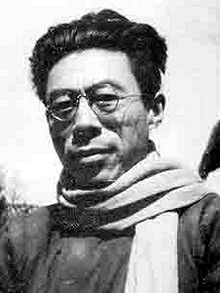
Wen Yiduo (1899-1946) lived during a tumultuous period of China's history: end of the Empire (1912), the Warlord period of the 1920s, the Japanese invasion  and WW II (1937-1945), and was assassinated in 1946 for his political activities as part of a democratic group caught between the Nationalists and the Communists.  Following graduation from Tsinghua University in Beijing (also my father's alma mater, class of 1937), Yiduo studied at The Art Institute of Chicago, later returning to China to teach and write.  I chose him for two reasons.  First, my father would have both read and known him - if not directly, then indirectly - because both were politically/patriotically active during the Japanese invasion/occupation (1937-1945), especially in Beijing in the period immediately following the invasion, and both were Tsinghua alumni, a very close-knit and connected group as graduates of China's top university.  Secondly, because I love the last stanza.
-----------------------

We are one body!
Our union
Is as round and perfect as the globe.
But you are the Eastern hemisphere,
And I the Western,
The tears that we ourselves have shed
Made this vast Pacific,
Cutting us in two.

                               *

I send these poems to you,
Even if you do not know all the words,
It doesn’t matter.
With your fingers you can
Gently caress them,
Like a doctor feeling a patient’s pulse,
Perhaps you can detect in
Their excited pulsations
The same rhythm as your own heart-beats.

                               *

Do you understand?
We are a pair of red candles
Shining on a wedding feast for guests;
We stand at opposite corners
Of the table,
Quietly burning away our lives,
Companions to their pleasure.
When they have eaten,
Our lives will have burnt away.
                                                                             Wen Yiduo  - Chinese

Sunday, April 4, 2010

Quick and Bitter - A. Amichai

#3 from Yehuda Amichai (also here In the Middle of This Century, A Precise Woman  thus far). I wish that I could read them in the original Hebrew: if it's this powerful in translation, it's hard to imagine how it must be in the original.  I do not know another poem that is as perfect as this one for its subject matter.
----------------------------
Quick and Bitter
                                                             transl. from Hebrew by Guttman
The end was quick and bitter.
Slow and sweet was the time between us,
slow and sweet were the nights
when my hands did not touch one another in despair
but in the love of your body
which came between them.

And when I entered into you
it seemed then that great happiness
could be measured with the precision
of sharp pain. Quick and bitter.

Slow and sweet were the nights.
Now is bitter and grinding as sand –
“Let’s be sensible” and similar curses.

And as we stray further from love
we multiply the words,
words and sentences so long and orderly.
Had me remained together
we could have become a silence.
                                                                                      Yehuda Amichai - Israeli

Saturday, April 3, 2010

Variations - A. Gregor

It's bad enough when a poet is referred to as "lesser-known" or "minor", but Arthur Gregor (1923-   ) not only hasn't merited a bio on the Poetry Foundation site, but no one has bothered even to provide a bio on Wikipedia!  He deserves better.   (His poetry is spiritual tinged with mysticism, which sometimes translates into being hard to connect with.) I came across him during the early 70s through his "Selected Poems" and liked several, including this one.  It needs to be read more than once and with close attention, but the effort is worthwhile.   He has written several volumes of poetry plus a memoir.  Gregor was born in Vienna and fled the Nazis in the weeks right after WW II began in 1939.  (He lives in Paris now and is available for readings.)
---------------------------------
Variations

1.
Everything alive is sensitive.
You are off with someone else
looking at autumn leaves.
The musical key this stirs in me
comes from
helplessness, acceptance, rage –
like you, like your new love, or friend,
a body
for feelings
the inevitable conflict brings.

2.
Imagine fireworks from barges,
royal outings along the Thames,
plumes, ruffles, modes of
eighteenth-century elegance, or
other characteristics of an age.
Time intrudes. Black clouds
rifting in moonlight. A cry
no one utters, no one hears
rips the night –
conflict playing on
the dreamer as though
being
were a musical instrument.

3.
Everything alive is sensitive.
If not a phoenix, a dove,
(all right, a pigeon) lifts from
the fire of autumn leaves,
driven out of summer’s death
in response to what
no one can hear or guess.
The very air vibrates
colors of fire and of fur
suggesting
something somewhere is astir –

4.
more than my pain
caused by you
who do not mean to harm.
Needs often interact.
Not what the mind can grasp
but what is secret in us
determines what we do.
The fire has shifted far into
the sky, a single leaf
ablaze like a cry
floats toward the bank
where in the early dark-
as though
still waiting for a boat –
the human figure stands.
                                                                   Arthur Gregor - American

Sunday, March 28, 2010

it may not always be so - e.e. cummings

If there is too little love poetry from Jarrell (yesterday's selection), the opposite is true with e.e. cummings (1894-1962).  Fertile in his output, choosing something from him is like selecting a chocolate from an assortment box: there is one to satisfy any craving and even the wrong pick is someone else's favorite.  He will be well-represented during the run of this blog.  Cummings is  perennially popular and re-discovered by every generation of love-sick college students wanting quotable poems.  In his Complete Poems, a tongue-tied freshman could find enough love poems - fitting every occasion and lass - to last him through all four undergraduate years.   Cummings experiments with punctuation, syntax, etc.  and the sensuality and sexuality in his work added to the appeal.  Fortunately (or unfortunately), I did not get a copy of it until Spring of my third-year or else I would have read fewer poets... This one was an early favorite.  It has a sweetness and romanticism that still cuts through the cynical layers life inevitably forces on us as protective covers.   (I say "force" because who would choose cynicism as a life-style??) I like this poem for that ability and also for its clearly-impossible-to-follow example of how to be in real life in that situation!  
------------------------------
it may not always be so

it may not always be so; and i say
that if your lips, which i have loved, should touch
another's, and your dear strong fingers clutch
his heart, as mine in time not far away;
if on another's face your sweet hair lay
in such a silence as i know, or such
great writhing words as, uttering overmuch,
stand helplessly before the spirit at bay;

if this should be, i say if this should be --
you of my heart, send me a little word;
that i may go unto him, and take his hands,
saying, Accept all happiness from me.
Then shall i turn my face, and hear one bird
sing terribly afar in the lost lands.
                                                                                                      e.e. cummings - American

Thursday, March 25, 2010

Lovers - S. Dunn

Dunn won a Pulitzer in 2000 for Different Hours but it's lines like the last one in this one, with its dark truth, that tell me he's "got it".   Setting the stage for a line like that is difficult.  To do it and make it look effortless is what separates the hack from the poet.  *The link from his name is to his website.  He lives in Maryland and is available for evening or short rentals.  (Poets have to eat....)
-----------------------
Lovers
To keep the one you want
dig up a footprint of hers
and put it in a flowerpot.
Then plant a marigold, the flower
that doesn’t fade.
And love her.
If she’s distant now
it’s for a reason beyond control.
So don’t tamper with the impressions
left by her body when
for the last time
she leaves your bed.
Just smooth them out and forget her.
Who is not vulnerable
to a stronger magic (the
broken glass, the bullets
in a yawn),
the terrible power of the one less in love.

                                                                                     Stephen Dunn - American  (desolation)