Showing posts with label My favorites. Show all posts

Monday, November 22, 2010

The Surly One - Theodore Roethke

If this is the only Roethke poem you will read here, you'll be doing yourself a disservice.  Pleeease "click" on his name on the left and check out the others!  He has written some of the most dazzling love poems that I know: joyous, playful, with imagery that will surprise by their freshness.  This one is short and, thus, might look simple and not worth a second read.... but take your time!  Boil some water, and while the tea steeps let the lines loose among your emotional memoriesYou will be surprised at what they can stir up, if you let themI like #1, perhaps because of my fondness for single malt whiskeys, as they evoke my chosen connection to Scotland.  (However, unlike Roethke, I SIP, not slug them down to drown memories.)  In #2, it's how he condenses so much truth in the last two lines. 
------------------------------------------------------------
 The Surly One

1

When true love broke my heart in half ,
I took the whisky from the shelf,
And told my neighbors when to laugh.
I keep a dog, and bark myself.

2

Ghost cries out to ghost –
But who’s afraid of that?
I fear those shadows most
That start from my own feet.

                                                                Theodore Roethke

Tuesday, November 9, 2010

Reply to "Phoenix Hairpin" (to the tune of) - Tang Wan

This is the only translation I could find (from The Anchor Book of Chinese Poetry) of Tang Wan's poem in reply to her ex-husband Lu You's poem.  (See two postings below.)  There is something unsatisfying about it: I can't tell whether it's the poem or the translation.  Somehow, given how she must have felt, the fullness of her feelings doesn't come across.  There is flame but little heat and I can't believe that is how it was for her.  The sorrow of a love torn asunder, a love big enough to kill her less than a year after that meeting: it just doesn't come through strongly enough.  We know his broken heart lasted the rest of his life, another forty years, but that's what a great love will do. I wonder, if given the option of a short or long life after a loss like that, which would be the easier.  But we are not given that choice.  I know.

Addendum: Jan. 22, 2011.  Since no longer being able to add more poems after the fire of Dec. 21., I have been "visiting" poems whose physical copies burned.  I feel that I have done Tang Wan a disservice with my original remarks.  I see her sorrow now as so deep, so profound that it's past the stage of torrents of tears and words.  She is now at a place where what remains is the bleakness of the loss and a vocabulary of images as stark and limited as her life.  I remember reading somewhere that the purest truths are said in the shortest sentences and with the simplest of words.  (No, not Hemingway.)  Read with that in mind, I can feel her devastation in my marrow.  Contrast it with his, forty years after that chance encounter... and leave me a comment.)
----------------------------------------

 Reply to “Phoenix Hairpin”  (to the tune of)  -  Tang Wan

Human relationships are short.
Human intentions are evil.
When rain accompanies evening, flowers fall easily,
but morning wind is dry.
Tearstains remain.
I want to write you my feelings
but I only whisper to myself, leaning against banister.
Hard!  Hard!  Hard!

We are separate.
Today is not yesterday.
My sick soul moves like a swing between us.
A cold blast from a horn.
The night is late.
Afraid of questions,
I swallow my tears and smile.
Hide!  Hide!  Hide!

                                                             Tang Wan - dates unknown, Song Dynasty ,

Thursday, August 12, 2010

Sonnet LXIX - 100 Sonnets of Love - Pablo Neruda

Regardless, of how this poem arrives on your physical (or virtual) doorstep - by dogsled, singing messenger,  snail-mail, spam, or even in a blog you stumble upon, it should be taken very, very seriously as a reminder that life is short and The Beatles had it almost right: Love may not be all you need, but without it, what is the rest?  And if it arrives by carrier pigeon with a flash-drive attached to a leg or delivered by Federal Express, you would be a fool NOT to run - not walk - to the person who sent it.  How much more could you ask for from someone IF their other actions match the ardor, passion, and devotion in these words???

------------------------------------
Sonnet LXIX
                                          transl. - Stephen Tapscott

Maybe nothingness is to be without your presence,
without you moving, slicing the noon
like a blue flower, without you walking
later through the fog and the cobbles,

without the light you carry in your hand,
golden, which maybe others will not see,
which maybe no one knew was growing
like the red beginnings of a rose.

In short, without your presence: without your coming
suddenly, incitingly, to know my life,
gust of a rosebush, wheat of wind:

since then I am because you are,
since then you are, I am, we are,
and through love I will be, you will be, we’ll be.

                                                                                              Pablo Neruda

Sunday, June 27, 2010

I Am Much Too Alone In This World

Rainer Maria Rilke (1875-1926) almost exactly straddles the 19th and 20th century, dying of leukemia at age 51 in Switzerland, though his best literary years were in Paris (1902-1914) where, for a time, he was Rodin's secretary(!).  Both a poet and a novelist, he was admired by his contemporaries but not broadly popularized until after his death.  His reputation has grown over time, his lyrical style, of which this selection is not a prime example, striking. 

For me, this poem captures that yearning to know and be known - authentically, purely - that should be at the start of every love.  It's a manifesto of good intentions that, hopefully, can be carried out through the right balancing of risk/self-protection.  It's also a plea that, one hopes, is shared by the love object and to the same degree.  

(I chose this oil of him vs. a photograph since this is more flattering.  By far.)

I am much too alone


I am much too alone in this world, yet not alone
enough
to truly consecrate the hour.
I am much too small in this world, yet not small
enough
to be to you just object and thing,
dark and smart.
I want my free will and want it accompanying
the path which leads to action;
and want during times that beg questions,
where something is up,
to be among those in the know,
or else be alone.


I want to mirror your image to its fullest perfection,
never be blind or too old
to uphold your weighty wavering reflection.
I want to unfold.
Nowhere I wish to stay crooked, bent;
for there I would be dishonest, untrue.
I want my conscience to be
true before you;
want to describe myself like a picture I observed
for a long time, one close up,
like a new word I learned and embraced,
like the everyday jug,
like my mother's face,
like a ship that carried me along
through the deadliest storm.


Let's invite something new
by unifying our silences;
if, then and there, we advance,
we'll know it soon enough.

                                                                   Rainer Maria Rilke (transl. by Annemarie S.Kilder)

Friday, May 28, 2010

Living In Sin - Adrienne Rich

Another by Adrienne Rich (bio info with earlier).  I love the line "By evening she was back in love again / though not so wholly...."  and how true it is that even the separation of just the working hours gives pause enough for reflecting - deluding? - ourselves that the bastard/bitch is a saint - though slightly soiled (and more so each day).  Or why retired couples sometimes find that, without that daily apartness, all the sins are magnified, sometimes beyond repair.  Yet, it does wear thin, especially if the man is as obtuse and self-involved as this one.  One pulls for the woman (girl? she seems young) to truly wake and leave, though we know she won't....
-----------------------------------------
Living In Sin

She had thought the studio would keep itself –
No dust upon the furniture of love.
Half heresy, to wish the taps less vocal,
The panes relieved of grime.  A plate of pears,
A piano with a Persian shawl, a cat
Stalking the picturesque, amusing mouse
Had been her vision when he pleaded “Come.”
Not that, at five, each separate stair would writhe
Under the milkman’s tramp; that morning light
So coldly would delineate the scraps
Of last night’s cheese and blank, sepulchral bottles;
That on the kitchen shelf among the saucers
A pair of beetle eyes would fix her own –
Envoy from some black village in the moldings….
Meanwhile her night’s companion, with a yawn,
Sounded a dozen notes upon the keyboard,
Declared it out of tune, inspected, whistling,
A twelve hours’ beard, went out for cigarettes,
While she, contending with a woman’s demons,
Pulled back the sheets and made the bed and found
A fallen towel to dust the tabletop,
And wondered how it was a man could wake
From night to day and take the day for granted.
By evening she was back in love again,
Though not so wholly but throughout the night
She woke sometimes to feel the daylight coming
Lke a relentless milkman up the stairs.

                                                                               Adrienne Rich -  American


Thursday, May 27, 2010

Me To You - Alastair Reid

Probably the best-known Scottish literary figure alive outside Scotland, Alastair Reid (1926 -  ) moves easily between essays, translations (Neruda, in particular), poetry, children's books, and articles for The New Yorker.  While he's lived outside Scotland for much of his adult life, there is something - to me - very Scottish in his writing: a sober yet wistful tone that never gets maudlin but acknowledges both the beauty and hardness of life there, a Gaelic version of stoicism.  (Or, I am just projecting from first-hand observations of the Scottish character over three decades of regular trips!)   This poem has those elements, coming close (on one level) to evoking that Brazilian sensation of "saudade", a word without an English equivalent, that I once described as ".... a longing, not just for one's own home and family, but for the vibrancy, the soul and heart of a place and culture....".
-----------------------------------------------------
Me To You

Summer’s gone brown, and, with it,
our wanderings in the shires, our ways.
Look at us now.
A shuttered house drips in Moroccan rain.
A mill sits ghostly in the green of France.
Beaches are empty now of all but pebbles.
But still, at crossroads, in seignorial gardens,
we meet, sleep, wrangle, part, meet, part,
making  a lodging of the heart.

Now that the sea begins to dull with winter,
and I so far, and you so far
(and home farther than either),
write me a long letter,
as if from home.

                           Tell me about the snowfalls
at night, and tell me how we’d sit in firelight,
hearing dogs huff in sleep, hearing the geese
hiss in the barn, hearing the horse clop home.
Say how the waterfall sounds, and how the weeds
trail in the slithering river.
Write me about the weather.

Perhaps
a letter across water,
something like this, but better,
would almost takes us strangely
closer to home.

Write, and I’ll come.

                                                                    Alastair Reid -  Scottish

Wednesday, May 12, 2010

She - Theodore Roethke

 This is one of his more anthologized poems - and the second one in this blog - but that's not a reason to exclude it.   Comparing his imagery to, say Rod McKuen, is like comparing a Ferrari to  a Trabant: they both get you to a destination, but the rides are totally different.  Reading Roethke is always a joy to me because I can feel new pathways, new ways of seeing connections.  

This poem always conjures up for me that opening shot in "The Sound of Music",  when Julie Andrews is on a hill-top meadow singing "The Hills Are Alive With The Sound of Music".  She is so full of joy and exhilaration twirling, her arms and face to the sky.  This has that same euphoric joy and innocence.... and more.  Roethke's talent/genius is in seamlessly slipping in the sexual imagery without distracting from the overall "wholesomeness".   It's one of my favorite poems.
---------------------------------
She

I think the dead are tender. Shall we kiss? –
My lady laughs, delighting in what is.
If she but sighs, a bird puts out its tongue.
She makes space lonely with a lovely song.
She lilts a low soft language, and I hear
Down long sea-chambers of the inner ear.

We sing together; we sing mouth to mouth.
The garden is a river flowing south.
She cries out loud the soul’s own secret joy;
She dances, and the ground bears her away.
She knows the speech of light, and makes it plain
A lively thing can come to life again.

I feel her presence in the common day,
In that slow dark that widens every eye.
She moves as water moves, and comes to me,
Stayed by what was, and pulled by what would be.
                                                                                               Theodore Roethke - American

Sunday, May 9, 2010

New Year's Eve - D.H. Lawrence

So many of the poems thus far have had sleep-time, dreams, and dawn for settings that I felt it was time to choose one set to the evening hours before  sleep, when so much loving takes place.  And what better than one by D.H. Lawrence (1885-1930).... whose name is already synonymous with passion?  Lawrence is one of those slightly-larger-than-life characters, a fiercely independent thinker/writer (he declined joining the circle around Ezra Pound!), who is best known for one novel, though he wrote over a dozen in addition to collections of poetry and essays.  He lived away from England for many years after WW I because of public antipathy for his wife, who was German and rumored to have been for her homeland during the war.  Among the places he resided during this self-imposed exile was Santa Fe, NM, where literary groupies vied for his attentions.... Lawrence died in France at age 44.    I think of this poem as something that Mellors (Lady Chatterley's lover) could have written and tucked away: he was educated and well-read enough to do it.  In tone and content, it fits the passion (re)awakened by Connie...
------------------------------------------

New Year's Eve

There are only two things now,
The great black night scooped out
And this fireglow.

This fireglow, the core,
And we the two ripe pips
That are held in store.

Listen, the darkness rings
As it circulates round our fire.
Take off your things.

Your shoulder, your bruised throat!
Your breasts, your nakedness!
This fiery coat!

As the darkness flickers and dips,
As the firelight falls and leaps
From your feet to your lips!

                                                                             D.H. Lawrence - English

Friday, April 30, 2010

Mementos, I - W.D. Snodgrass

W.D. Snodgrass (1926 - 2009) earned a special place with me through the title poem - Heart's Needle - of his first book, which won the Pulitzer Prize in 1960.  (There is more in his obit about W.D.'s place in American poetry.) "Heart's Needle" is addressed to his daughter and expressed both his love for her and his pain and anguish at what his divorce from her mother brought (and took) from their lives.  When I first read it, years before my own marriage and fatherhood, I could only relate to it in a superficial way.  When I read it again, more than a decade later and as the father of a ten-year old daughter in the aftermath of his own divorce, I could not finish reading it for the tears.  Many years after that, I wrote to W.D. regarding the furor from some critics over his poems in the voices of Hitler's companions in the last days in the bunker.   (I thought they didn't understand that "humanizing" vs. demonizing the Nazis served to remind us that the potential for evil and darkness is within each of us and not just in a select few.  And, that knowing and acknowledging that truth is one of the safeguards against a repetition of that era.)  I also took the occasion to thank him for "Heart's Needle".  W.D. was gracious enough to write back a very personal letter, with which he included a signed copy of his book "W.D.'s Midnight Carnival".  It initiated a correspondence that I treasure still.  Among other things, he told me that the daughter to whom he wrote "Heart's Needle" grew up to become a minister and that she performed the wedding ceremony for one of his marriages!) 

The poem here is one of two about how encountering physical reminders of past loves cause us to come to terms anew each time with what they meant - and mean - to us.  I was still in my 20s and unacquainted with the how it would feel - much later, post-marriage and divorce - when going through boxes of my own mementos.  I have yet to read a better poem that better captures the sorrow, regrets, and bittersweetness of such an occasion.  
-------------------------------
Mementos, I

Sorting out letters and piles of my old
   Canceled checks, old clippings, and yellow note cards
That meant something once, I happened to find
   Your picture.  That picture.  I stopped there cold,
Like a man raking piles of dead leaves in his yard
         Who has turned up a severed hand.

Still, that first second, I was glad: you stand
   Just as you stood – shy, delicate, slender,
In that long gown of green lace netting and daisies
   That you wore to our first dance.  The sight of you stunned
Us all.  Well, our needs were different, then,
         And our ideals came easy.

Then through the war and those two long years
   Overseas, the Japanese dead in their shacks
Among dishes, dolls, and lost shoes; I carried
   This glimpse of you, there, to choke down my fear,
Prove it had been, that it might come back.
         That was before we got married.

--Before we drained out one another’s force
   With lies, self-denial, unspoken regret
And the sick eyes that blame; before the divorce
    And the treachery.  Say it, before we met.  Still,
I put back your picture.  Someday, in due course,
         I will find that it’s still there. 
                                                                                           W.D. Snodgrass - American

Saturday, April 24, 2010

For Nobody Else -- David Ignatow

 (Bio info about Ignatow is with his first poem in the blog.  This is one of my favorites - no need to explain why.)
---------------------------------------------------------------
For Nobody Else

She presents me with a mountain
which to possess I first must climb.
At the start I must enter a tunnel
that winds in darkness to the top.
In my extremity, my breathing forced,
at my topmost fear as I labor,
she who has hidden her face
turns to greet the high noon burst
upon our eyes.

Lie quietly by my side
as a still lake reflecting
its mountain, my heart beats
on your heart
as we hold each other’s breathing
in our arms,
our backs on darkness
light on our breaths,
safe at last
to hold you,
you place your hands
upon my back
in the shadows.

I need to see and touch
and talk to you each day
to assure myself
I am not made happy with dreams.
Then you become for me a tree
of comforting shade, bellying
where the branches bunch together
full of leaves.
I want a maternal world.

Sadly is how I must say it
because you have many sisters
and I am brother to many brothers.
Should we then not become many happinesses,
become many starts of love,
as we fade into a crowd of faces
awaiting our bed?

My body grows pale with effort
into the milky dawn.
I succeed in acting one more day,
you already dressed and moving about,
a person with a coffee pot.
I stick out my tongue
to touch the brightening sky.

How do I know that tomorrow you will live?
Do you know how much you mean to me?
At the thought of your death
all thought stops in me,
I catch my breath.
                                                                             David Ignatow - American

Thursday, April 22, 2010

Anonymous (Japanese - 10th Century)

The only thing I learned from a college philosophy course was something from Ludwig Wittgenstein which I always paraphrase as: "If you have nothing to say, shut up".  (The actual quote is : "Whereof one cannot speak, thereof one must be silent.")   That applies to commenting on today's poem:
----------------------------------------------
Anonymous - Japanese  10th Century

Early morning glows
in the faint shimmer
of first light.
Chocked with sadness,
I help you into your clothes.


Wednesday, April 21, 2010

Ballad of Love Through the Ages - Carlos Drummond de Andrade

As every Brazilian school-boy knows, today marks the 510th Anniversary of the "discovery" of Brazil in 1500 by the Portuguese admiral Dom Pedro Álvares de CabralTo celebrate the fact that I still remember his full name AND the size of his fleet (13 ships, 1,500 hundred men) from grade-school history classes, today's poem comes from Brazil: another one by Carlos Drummond de Andrade, the acknowledged greatest 20th Century poet writing in Portuguese.   As in my comments with his first poem here, I wish that you could read and hear it in the original.  However, this is the next best thing: a translation by Mark Strand, a poet in his own right, who, like Elizabeth Bishop, brought the necessary poetic soul, skills, and sensitivity to do it justice.  This isn't a poem at Drummond's lyrical best or most complex in meaning or imagery, but it has always charmed me because of its simplicity, humor, and scope. 
------------------------------------------------
Ballad of Love Through the Ages
                                                                   transl. by Mark Strand
From the beginning of time,
I liked you, you liked me.
I was Greek, you were Trojan,
Trojan but not Helen.
I sprung from a wooden horse
to kill your brother.
I killed, we quarreled, we died.

I became a Roman soldier
persecutor of Christians.
At the catacomb door
I met you again.
But when I saw you fall
naked in the Colosseum
and the lion coming toward you,
I made a desperate leap
and the lion ate us both.

Next I was a Moorish pirate,
the scourge of Tripoli.
I set fire to the frigate
where you were hiding from
the fury of my brigantine.
But when I went to grab you
and take you as my slave,
you crossed yourself and drove
a dagger through your heart.
I killed myself as well.

Later on, in happier days,
I was a courtier at Versailles,
clever and debauched.
You dreamed of being a nun…
I vaulted over the convent wall
but difficult politics
led us to the guillotine.

These days I’m totally modern:
dancing, jogging, working out.
And I have money in the bank.
And you’re a fabulous blonde:
dancing, jogging, working out.
None of it pleases your father.
But after a thousand reversals,
I, one of Paramount’s heroes,
give you a hug, a kiss, and we marry.
                                                                            Carlos Drummond de Andrade - Brazilian

Sunday, April 18, 2010

For Losing Her Love All I Would Profane - Kenneth Patchen

I came across Kenneth Patchen's (1911-1972) Selected Poems the year after his death.  He was a little too old to be part of the "Beat Poets" but his experimentation with different forms and ways of conveying poetry, including the first reading with a jazz group and his "painted poems", certainly put him outside the academic mainstream.  He was a prolific poet, with many published volumes, as well as a novelist.  Late in life (1967) he received a life-time achievement award from the National Foundation on the Arts and Humanities.  (Not bad for someone who, in his younger years and after dropping out of college, traveled widely around the USA as a migrant worker.)  For the last years of his life, he was mostly bedridden from an operation that had gone badly.  This blog is about "love poetry", so there won't be examples of Patchen's war poems, which are as heartfelt and powerful as any I have ever read.   

In my early 20s, the poem below jolted me with the first two lines of each stanza, while the cry in the last line is far more plaintive now than then: experience and the intervening years - as they should - make it less rhetorical and more real.
----------------------------
For Losing Her Love All Would I Profane

For losing her love all would I profane
As a man who washes his heart in filth.
She wakes so whitely at my side,
Her two breasts like bowls of snow
Upon which I put my hands like players
In a child’s story of heaven.

For gaining her love all would I protest
As a man who threatens God with murder.
Her lips part sleep’s jeweled rain
Like little red boats on a Sunday lake.
I know nothing about men who die
Like beasts in a war-fouled ditch –
My sweetling….

O God what shall become of us?
                                                                             Kenneth Patchen - American

Wednesday, April 14, 2010

Guitar Recitativos - A.R. Ammons

 Of all of A.R. Ammons' (1926-2001) poems, this is hands-down my favorite and also on my "all-star" poems list.  Awards and honors (of which he had many: two National Book Awards, a McArthur "genius' award, the Bollingen) are at once meaningful and meaningless: it's the poems themselves that count.  And if there is ONE poem in this blog that will serve you well with a lover, THIS one is it.  So, follow these instructions.  First, read it enough times to feel as though you wrote it, then practice reading it aloud.  Treat it like a jazz piece, each verse a riff on the theme.  Don't be afraid to read it LARGE, with feeling: it's a joyful, lively, happy poem.  Your tone should be conversational, not oratorical or stentorian, as though it's just YOU talking to HIM/HER.  When you are ready to share and, depending on the season and weather: a) pack a picnic, including a bottle of sparkling wine and head to a place of beauty and quiet, or b) stay home, cook their favorite meal, leave the clean-up for the morning.  When you are ready, in either scenario, charge your glasses, make sure he/she is comfortable, and start.... You can thank me later.  (P.S. For the florally challenged - of which I am one - "clicking" on words highlighted will take you to images of the flowers.  For extra points, you could make a bouquet to have at hand...)
------------------------------------------------
Guitar Recitativos

1

I know you love me, baby
I know it by the way you carry on around here certain times
         of the day and night
I can make the distinction between the willing and the
         unrefusable
That’s not what I’m talking about
That’s not what I need
What I mean is could you just peel me a few of those grapes
         over there
I want to lie here cool and accumulate
Oh say about half a bunch
That’s what I need – flick out those little seed –
Just drop them in here one at a time
I’m not going anyplace, baby, not today
Relax – sneak the skin off a few of those grapes for me, will you?

2

Baby, you been stomping round on my toes so long
they breaking out in black and blue hyacinths,
well-knit forget-me-nots
Geraniums are flopping out over the tops of my shoes
tendril leaves coming out along the edges of my shoelaces
Gladioli are steering out of the small of my back
strumming those cool stalks up  my spine
Zinnias radiating from the crock of my neck
and petunias swinging down bells from my earlobes
All this stomping around on me you been doing, baby,
I’m gonna break out in a colorful reaction
I’m gonna wade right through you
with the thorns of all these big red roses

3

I’m tired of the you-and-me thing
I am for more research in to the nature of the amorous bond
the discovery of catalysts for speeding-up, wearing out,
         and getting it over with
or for slowing it down to allow long intervals of looseness

Baby, there are times when the mixture becomes immiscible
and other times we get so stirred up I can’t tell
whether I’m you or me
and then I have this fear of a surprising reaction in which
we both turn into something else

powdery or gaseous or slight metallic
What I means is this whole relationship is, lacking further
knowledge, risky: while there’s still time, why
don’t you get yourself together and I’ll

get myself together and then we’ll sort of shy out
of each other’s gravitational field, unstring the
electromagnetism, and then sort of just drop this
whole orientation, baby

4

I can tell you what I think of your beauty, baby,
you have it, it’s keen and fast, there’s this
glittery sword whipping about your head all day
and, baby, you make people snap – you condescend

and a surprised little heart splatters or you turn your
cold head away and a tiny freeze kills a few
cells in some man’s brain – I mean, baby, you
may be kind but your beauty, sweetie, is such

many a man would run himself through for
hating your guts every minute that he died for you

5

You come in and I turn on:
freon purrs and the
refrigerator breaks out with hives of ice:
the Westinghouse portable electric fan flushes
my papers all over the room:
the waffle-iron whacks down sizzling imaginary waffles:
one paper glues itself and billows to the back of the fan,
my nerves nervous as newspapers:

I tell you, you are a walking calamity
and when you sit down there is hardly less activity:
the alarm clock breaks out raging its held cry
and the oven in the kitchen sets itself for broil:
I mean the gas-jet in the incinerator bloops on
and, frankly, the mechanisms in my legs – I hope you
         never find out – jerk:
Oh, beauty, beauty is so disturbingly nice.


                                                                                       A.R. Ammons - American

Tuesday, April 13, 2010

The Silent Lover - Louis Simpson

Louis Simpson (1923 - ).  I haven't read much of the recent Simpson, but have always liked his work and appreciate it more now.  If it makes sense, in earlier years I wanted to be dazzled by a poet's visible command of the language, control of poetic forms, and  the complexity in the imagery.  

Now, I am also drawn to poems and language that is "simple" yet require more from me: to slow down, to reflect and allow my own experiences to inform my connection to the poem.  I know some of it comes from reading Chinese poetry and some from being older.  There is a richness to this one .....if you don't rush and let it meld with you. 

It's a poem that goes with sitting on the porch of a beach house in the late afternoon sipping  tea.  Or, for myself, sipping a 20 yr. old single cask bottling of Highland Park and recalling the urban hike to its distillery on an overcast August day after the ferry ride from Aberdeen to Kirkwall….. and the memory nestled within that memory: my thoughts during that hike, which included the beautiful last line of this poem and how it can stand alone, a complete poem just by itself.

---------------------
The Silent Lover

She sighs. What shall I say?
For beauty seems to grow
In silence, when the heart is faint and slow.

Sing, sing…How shall I sing?
In silent eyes, where clouds and islands gaze,
The waves bring Eros in.

I think the rustling of her clothes
Is like the sea, and she
A wild white bird,

And love is like the sighing of the sand.
                                                                                         Louis Simpson - American

Sunday, April 11, 2010

Sonnet on Fidelity - Vinicius de Moraes

Another by Vinicius de Moraes (see yesterday's post).  I wish that you could hear it in the original Portuguese.  And if you think French accents are sexy, you need to hear a Brazilian Portuguese speaker talk in English.... Alas, most of my Brazilian Portuguese accent is gone... but not the spirit!
--------------------------------------
Sonnet on Fidelity

Above all, to my love I’ll be attentive
First, and always with such ardor, so much
That even when confronted by this great
Enchantment my thoughts ascend to more delight.

I want to live it through in each vain moment
And in its honor I must spread my song
And laugh with my delight and shed my tears
When she is sad or when she is contented.

And thus, when afterward comes looking for me
Who knows what death, anxiety of the living,
Who knows what loneliness, end of the loving

I could say to myself of the love (I had):
Let it not be immortal, since it is flame
But let it be infinite while it lasts.
                                                                                Vinicius de Moraes - Brazilian

Saturday, April 10, 2010

Sonnet on Separation - Vinicius de Moraes

Ahhh.... Vinicius de Moraes (1913-1980)!  Probably the most beloved and popular Brazilian poet of the last fifty years.  Boulevadier of Rio's grand avenues, raconteur, bon vivant, diplomat (posted to France, UNESCO, and Los Angeles!), playwright, performer, acclaimed lyricist of the Bossa Nova period, especially in collaboration with Antonio Carlos Jobim, and later with Chico Buarque, Baden Powell, and others. 

Vinicius lived large, married eight times (tying Mickey Rooney and Larry King!), wrote beautiful, beautiful poems that celebrated and embodied everything Brazilian, especially the embracing equally of life's joys and tribulations.  One of his plays became the movie "Black Orpheus", which, in 1959, hit the trifecta, winning the Oscar for Best Foreign Picture here and the equivalent awards in France and England.  (It's a MUST see, for the music and dancing alone!)  Perhaps his best known work worldwide are the lyrics to "The Girl From Ipanema".  Coincidentally, I was in Rio, on my first trip back to Brazil since leaving for America as a teenager, when he died in July 1980.  I remember seeing people in the hotel bar and club dancing to his songs while crying at the same.  I chose this poem because it encompasses that duality of living/loving fully while accepting how quickly it can change.  (If you click on his name at the end of the poem, it will take you to a site where you can both read more about him and hear some of the songs he wrote.)
------------------------------
Sonnet on Separation
                                                              translated from Portuguese by Ashley Brown
Suddenly laughter became sobbing
Silent and white like the mist
And united mouths became foam
And upturned hands became astonished.

Suddenly the calm became the wind
That extinguished the last flame in the eyes
And passion became foreboding
And the still moment became drama.

Suddenly, no more than suddenly
He who’d become a lover became sad
And he who’d become content became lonely

The near became the distant friend
Life became a vagrant venture
Suddenly, no more than suddenly.
                                                                                Vinicius de Moraes  - Brazilian

Thursday, April 8, 2010

Once a Great Love - Y. Amichai

#4 from Yehuda Amichai.  For the others, "click" on his name on the left column in the "Poets and Categories" section.)  It's poems like this one that make me read him in small doses.  There is no shade from its light and heat.  You are exposed because he has exposed himself, as that is the contract: to get the most from the gift of the poet's experience, the reader must also be willing to stand naked.

The first time I read this poem was just before a great love.  It had light, but little heat: I had no reference point.   The second time, its heat was unbearable: not enough years had passed after my life was cut in two.  Even now, before reading it, I gird myself first, like a furnace-worker putting on an asbestos suit.  

Note: This translation from Hebrew is noteworthy because Amichai worked with Ted Hughes, the English poet, who will forever be better-known as having been Sylvia Plath's husband than for his own writing....
---------------------------

Once a Great Love

Once a great love cut my life in two.
The first part goes on twisting
at some other place like a snake cut in two.

The passing years have calmed me
and brought healing to my heart and rest to my eyes.

And I’m like someone standing in
the Judean desert, looking at a sign:
“Sea Level.”
He cannot see the sea, but he knows.

Thus I remember your face everywhere
at your “face level.”
                                                                                       Yehuda Amichai - Israeli

Tuesday, April 6, 2010

Contradictions: Tracking Poems - Adrienne Rich

My selection comes from Rich's work from the mid-1980s, when her reputation was more than solidified as a leading poet and a strong feminist (and lesbian) voice.  Born in 1929, she led a conventional life (husband, three kids) until the 1960s, when she found an adult voice ignited by the socio-political changes of that period.  (Crap, this is sounding like a college paper...)  I first encountered Rich in 1974 through her volume - Diving Into The Wreck - that won the National Book Award  that year.  She isn't known for her love poetry: her passion is for the "bigger" themes of her struggles to liberate herself (and women of her generation) from the restraints of male-dominated society, but such energy as is diverted to "Love" produced poems with heat.  (There is a volume called  Twenty One Love Poems that's worth the effort to find and read.)  I like this one for its compactness in painting a specific place and time, particularly the line "stopping to laugh at a joke", which says so much about the people and the relationship.
---------------------------------
3.

My mouth hovers across your breasts
in the short grey winter afternoon
in this bed        we are delicate
and tough        so hot with joy we amaze ourselves
tough        and delicate        we play rings
around each other        our daytime candle burns
with its peculiar light        and if the snow
beings to fall outside        filling the branches
and if the night falls        without announcement
these are the pleasures of winter
sudden, wild and delicate        your fingers
exact        my tongue exact at the same moment
stopping to laugh at a joke
my love         hot on your scent        on the cusp of winter     
                
                                                                                                   Adrienne Rich - American

Monday, April 5, 2010

from Scarlet Beads - Wen Yiduo

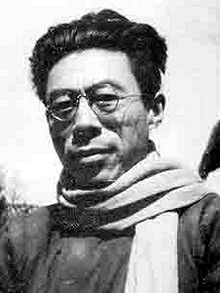
Wen Yiduo (1899-1946) lived during a tumultuous period of China's history: end of the Empire (1912), the Warlord period of the 1920s, the Japanese invasion  and WW II (1937-1945), and was assassinated in 1946 for his political activities as part of a democratic group caught between the Nationalists and the Communists.  Following graduation from Tsinghua University in Beijing (also my father's alma mater, class of 1937), Yiduo studied at The Art Institute of Chicago, later returning to China to teach and write.  I chose him for two reasons.  First, my father would have both read and known him - if not directly, then indirectly - because both were politically/patriotically active during the Japanese invasion/occupation (1937-1945), especially in Beijing in the period immediately following the invasion, and both were Tsinghua alumni, a very close-knit and connected group as graduates of China's top university.  Secondly, because I love the last stanza.
-----------------------

We are one body!
Our union
Is as round and perfect as the globe.
But you are the Eastern hemisphere,
And I the Western,
The tears that we ourselves have shed
Made this vast Pacific,
Cutting us in two.

                               *

I send these poems to you,
Even if you do not know all the words,
It doesn’t matter.
With your fingers you can
Gently caress them,
Like a doctor feeling a patient’s pulse,
Perhaps you can detect in
Their excited pulsations
The same rhythm as your own heart-beats.

                               *

Do you understand?
We are a pair of red candles
Shining on a wedding feast for guests;
We stand at opposite corners
Of the table,
Quietly burning away our lives,
Companions to their pleasure.
When they have eaten,
Our lives will have burnt away.
                                                                             Wen Yiduo  - Chinese