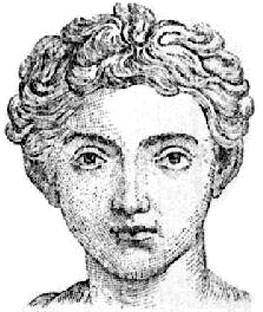
A Roman Consul, courtier, and "fashion-advisor" to Emperor Nero, Gaius Petronius (27- 66 C.E., also known as Petronius Arbiter) was also the writer to whom "Satyricon" is attributed. Petronius committed suicide rather than be executed for treason upon the accusation of political rivals.
In light of the mores of the Roman society of the time, this poem is fascinating for its urging for restraint in hurrying the course of Love into the physical dimension. It's a sensibility that pre-dates the Romantic love of the troubadors by over a 1000 years.
I've included it because its message is timeless and, perhaps, even more relevant in this age of "hook-ups". Just like the "slow food" movement, perhaps there should be a "slow-to-bed" initiative, where the imperative is less hormone driven - or, as the title of 1970 Student Health hand-book at U of Penn had it: "Sex is never an emergency" - so as to allow emotional intimacy to build ahead of - or at least apace with - the physical. To know what will happen, yet to wait.... so that when morning breaks, it is truly a new dawn. Sigh.
In light of the mores of the Roman society of the time, this poem is fascinating for its urging for restraint in hurrying the course of Love into the physical dimension. It's a sensibility that pre-dates the Romantic love of the troubadors by over a 1000 years.
I've included it because its message is timeless and, perhaps, even more relevant in this age of "hook-ups". Just like the "slow food" movement, perhaps there should be a "slow-to-bed" initiative, where the imperative is less hormone driven - or, as the title of 1970 Student Health hand-book at U of Penn had it: "Sex is never an emergency" - so as to allow emotional intimacy to build ahead of - or at least apace with - the physical. To know what will happen, yet to wait.... so that when morning breaks, it is truly a new dawn. Sigh.
------------------------------------------------------
Doing a filthy pleasure is
transl. from Latin by Ben Jonson
Doing, a filthy pleasure is, and short;
And done, we straight repent us of the sport:
Let us not then rush blindly on unto it,
Like lustful beasts, that only know to do it:
For lust will languish, and that heat decay.
But thus, thus, keeping endless holiday,
Let us together closely lie and kiss,
There is no labour, nor no shame in this;
This hath pleased, doth please, and long will please; never
Can this decay, but is beginning ever.
Gaius Petronius - Roman